

Understanding the New “Pulling” Hair Growth Study: What It Means for Hair Restoration
A recent study published in Nature Communications has made headlines by suggesting that human hair grows primarily through an “active pulling” force from the outer root sheath (ORS)—a sleeve-like layer around the hair shaft—rather than the traditional “pushing” from cell division in the hair bulb.1 Titled “Mapping cell dynamics in human ex vivo hair follicles suggests pulling mechanism of hair growth,” the research by Tissot et al. (2025) used advanced 3D live imaging on lab-cultured human scalp follicles to track cell movements.1 The authors propose that spiraling ORS cells generate traction via actin-myosin contractions, pulling the shaft upward like a “tiny motor,” even when proliferation is blocked.1 This challenges decades-old models where matrix cell division was seen as the main driver.2
As a board-certified hair restoration specialist with over 28 years and 30,000+ patients at Bauman Medical, I’ve fielded questions about this study from curious patients. While the science is exciting, it’s important to separate breakthrough insights from real-world implications for hair loss. Below, I’ll break down the study, its strengths and limitations, how it fits with established biology, and—most crucially—what it means for your treatment options.
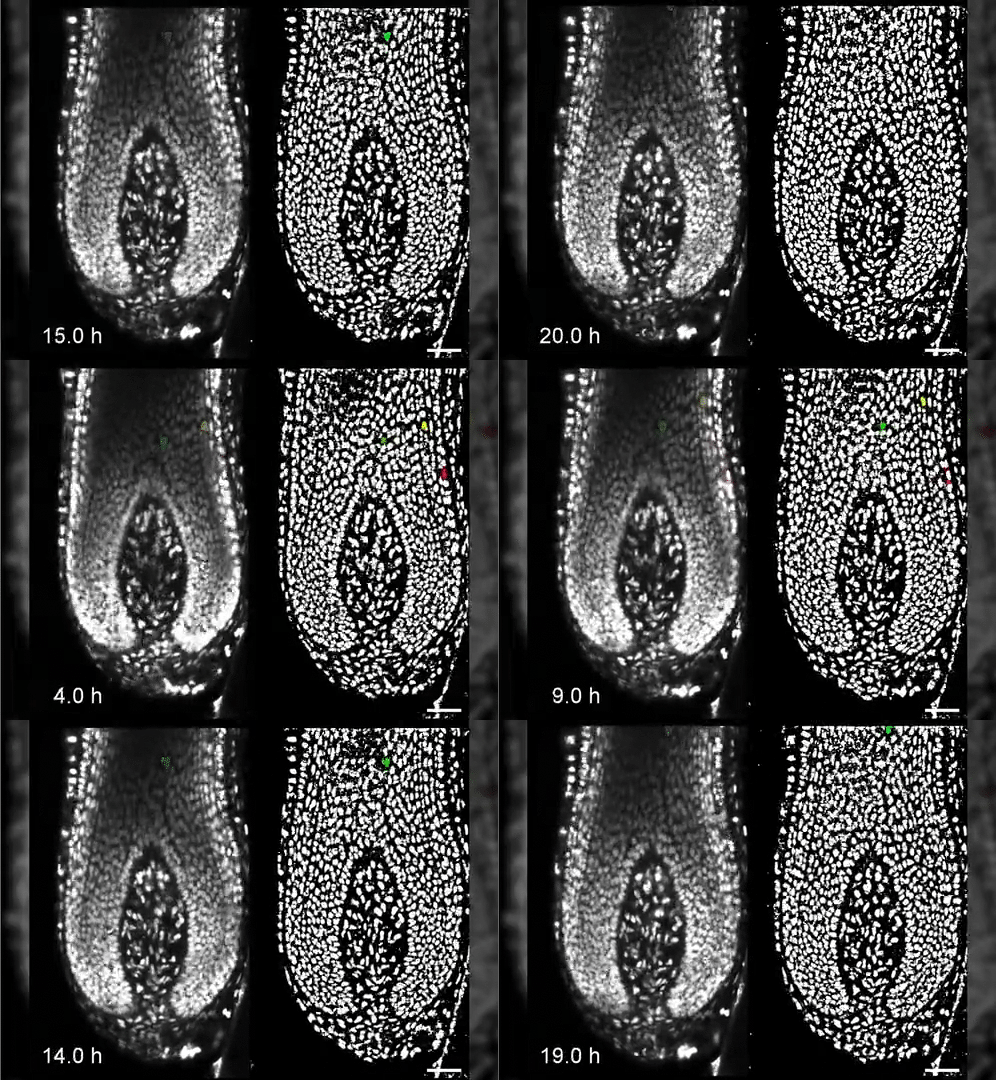
Tissot, N., Genty, G., Santoprete, R. et al. Mapping cell dynamics in human ex vivo hair follicles suggests pulling mechanism of hair growth. Nat Commun 16, 10267 (2025). https://doi.org/10.1038/s41467-025-65143-x
The Science Behind the Study: A Closer Look
Key Findings
- Imaging Innovation: Researchers dissected human scalp follicles from surgical samples and cultured them ex vivo (outside the body) in nutrient media. Using multiphoton 3D time-lapse microscopy, they visualized ~10,000–100,000 cells per follicle over 48–72 hours, revealing downward-spiraling ORS motility (~10–20 μm/min) that correlates with upward shaft extrusion (~300 μm/day).1
- Pulling Dominance: Blocking mitosis (cell division) with CDK1 inhibitors reduced proliferation by >90% but only slowed growth by 5–20%. Disrupting actin (with cytochalasin D) slashed traction forces and halted growth by 82%.1 Bulb removal still allowed shaft movement, pinpointing the force to the upper ORS.
- Modeling Support: Finite-element simulations (e.g., COMSOL) matched observations only when including ORS shear stress (~10–20 Pa), suggesting ~70–80% of force from pulling vs. 20–30% from proliferation.1
This builds on prior biophysical work, like actomyosin in epithelial sliding (e.g., Drosophila models) and traction in skin morphogenesis.3 It aligns with human-specific traits, like thicker ORS in terminal hairs, unlike rodent vibrissae.4
Strengths
- Human Focus: Avoids rodent biases; uses real scalp tissue for relevance.5
- Multi-Modal Rigor: Combines imaging, pharmacology, and computation with controls (n=12–30 follicles/experiment, p<0.01 stats).1
- Explains Anomalies: Why growth persists post-mitotic block (e.g., chemotherapy constrictions) or why anagen hairs resist plucking so fiercely.6
Critiquing the Study: Not a Total Overhaul
While innovative, the study refines—not revolutionizes—hair biology. Here’s a balanced view, grounded in 70+ years of research:
Limitations
- Ex Vivo Constraints: Cultures last 3–5 days, shortening anagen and omitting in vivo factors like blood flow, hormones, or immune cells.7 Scalp tension or neural inputs might modulate pulling in real skin.8
- Short-Term Scope: Tracks linear elongation, not caliber, cycling, or long-term viability. No data on ethnic/age variations or full anagen (2–7 years).7
- Causality Gaps: Strong correlations (r=0.85) but no optogenetics to prove ORS pulling causes growth. Proliferation still sustains matrix volume—blocking it long-term would fail.9
- No Direct Critiques Yet: As a fresh paper (Nov 2025), peer discourse is emerging, but early coverage notes hype risks (e.g., “overturns textbooks” ignores that old models were simplifications).10 Prior mechanics models emphasize dual forces (push-pull interplay via desmosomes and keratin hardening).11
Alignment with Established Knowledge
Hair cycles through anagen (growth, 85–90% follicles), catagen (regression, 1–2%), and telogen (rest, 10–15%).12 Matrix keratinocytes proliferate (~0.3–0.4 mm/day), differentiating into shaft/IRS under dermal papilla (DP) signals (Wnt/β-catenin, Shh, FGF).13 ORS provides anchorage via companion layer friction.3
The “pushing” view (e.g., StatPearls 2023) correlates proliferation with growth speed—chemo halts both.14 But pulling fits clinical realities: Anagen hairs (with IRS/ORS grip) need “explosive” force to pluck, unlike telogen clubs.15 Studies show anagen anchoring via actomyosin (50–100 pN/μm² traction).3 In miniaturized follicles (e.g., AGA), pulling persists despite weak output—matching our ACORN hair follicle stem cell harvesting experience.16
Multi-scale models confirm biomechanics matter: Follicle geometry, stiffness, and shear sliding tune protrusion while anchoring against pull-out.11 Yet, in alopecia, upstream issues (DP shrinkage, DHT-driven Wnt inhibition) dominate.17
Implications for Patients: Refinement, Not Revolution
This study spotlights mechanobiology’s role—echoing pulling in gut/lung development—but doesn’t rewrite alopecia care. Hair loss stems from cycle imbalance (short anagen, prolonged telogen) or miniaturization, not “broken pulling.”14 In AGA (50% men/25% women by 50), DHT shrinks DP, slashing proliferation before mechanics kick in.17 Shedding hits in catagen/telogen, when IRS/ORS degrade—pulling can’t prevent that.12
Why It Won’t Change Most Treatments
- Pulling Isn’t the Bottleneck: Miniaturized anagen hairs pull fiercely (per clinic pulls), but produce vellus shafts due to low matrix output.18 Enhancing contractility (e.g., ROCK inhibitors) shows no AGA wins; Wnt agonists do.13
- Proven Strategies Stay King:
- Pharmacology: Minoxidil (FDA-approved) boosts FGF/vascularization; finasteride blocks DHT (up to 66% less loss).19
- Biologics: PRP/exosomes target DP signaling, shifting telogen-to-anagen (8–14% gain).20
- Devices: LLLT (e.g., LaserCap) stimulates matrix (~32% density rise).21
- Transplants: FUE/FUT relocate robust follicles, bypassing mechanics.
Emerging Opportunities
- Niche Cases: Could guide therapies for loose anagen syndrome (weak grip) or lichen planopilaris (ORS inflammation).22
- Regen Med: Enhances organoids (DP-keratinocyte co-cultures) with traction substrates for better hair-like growth.23 Microneedles mimicking shear might boost delivery.24
- Holistic Tie-In: Stress/nutrition affect cycles; omega-3s prolong anagen via arachidonic acid.13 Biomechanics underscores why our metabolic support (e.g., nutrient IVs) aids.
The Bauman Medical Approach: Personalized, Evidence-Driven Care
At Bauman Medical, we view hair as a “metabolic marvel”—high-energy follicles demand holistic care.25 This study reinforces our focus: Restore signaling first, mechanics follow. Our process starts with a complete evaluation, which includes AI-powered microscopic hair density and hair caliber measurements, along with cross-sectional bundle HairCheck measurements.
- Treatment Ladder: From topicals to exosomes, we layer therapies for 70–90% response rates.
- Real Results: Patients see 20–50% density gains in 3–6 months; telogen drops 14% with biologics.
- Next Steps: Schedule an evaluation—virtual or in Boca Raton—for your custom plan.
This research is a step forward, but your hair health is about the full picture. Questions?
Reply or call us at 561-394-0024. Or schedule a comprehensive private one-on-one evaluation.
References available upon request. Last updated Dec 2025.
References
- Tissot N, et al. (2025). Mapping cell dynamics in human ex vivo hair follicles suggests pulling mechanism of hair growth. Nature Communications. https://doi.org/10.1038/s41467-025-65143-x.
- Biochemical mechanisms regulating human hair growth – PubMed – https://pubmed.ncbi.nlm.nih.gov/8003323/.
- Hair regeneration: Mechano-activation and related therapeutic … – https://pubmed.ncbi.nlm.nih.gov/41020043/.
- Review of Human Hair Follicle Biology: Dynamics of Niches and … – https://pubmed.ncbi.nlm.nih.gov/30324295/.
- Molecular mechanisms regulating hair follicle development – PubMed – https://pubmed.ncbi.nlm.nih.gov/11841536/.
- Using the Mechanisms of Action Involved in the Pathogenesis of … – https://pubmed.ncbi.nlm.nih.gov/41226747/.
- Deciphering the molecular mechanisms of stem cell dynamics in … – https://pubmed.ncbi.nlm.nih.gov/38182654/.
- Hair regeneration: Mechano-activation and related therapeutic … – https://pubmed.ncbi.nlm.nih.gov/41020043/.
- The Skin Microenvironment: A Dynamic Regulator of Hair Follicle … – https://pubmed.ncbi.nlm.nih.gov/41008641/.
- Human hair grows through ‘pulling’ not push – study – Queen Mary University of London – https://www.qmul.ac.uk/media/news/2025/medicine-and-dentistry/fmd/human-hair-grows-through-pulling-not-push–study-.html.
- Molecular Mechanisms Regulating Hair Follicle Development – https://www.sciencedirect.com/science/article/pii/S0022202X15415532.
- Immune niches for hair follicle development and homeostasis – https://pubmed.ncbi.nlm.nih.gov/38711955/.
- Recent Advances in the Role of Fibroblast Growth Factors in Hair … – https://pubmed.ncbi.nlm.nih.gov/40867641/.
- Role of Low-Level Light Therapy (LLLT) in Androgenetic Alopecia – PMC – https://pmc.ncbi.nlm.nih.gov/articles/PMC8906269/.
- Lichen Planopilaris – StatPearls – NCBI Bookshelf – https://www.ncbi.nlm.nih.gov/books/NBK470325/.
- Androgenetic Alopecia: Therapy Update – PubMed – https://pubmed.ncbi.nlm.nih.gov/37166619/.
- Androgenetic Alopecia: Therapy Update – PubMed – https://pubmed.ncbi.nlm.nih.gov/37166619/.
- Efficacy of non-surgical treatments for androgenetic alopecia – https://pubmed.ncbi.nlm.nih.gov/29797431/.
- An open, randomized, comparative study of oral finasteride and 5% topical minoxidil in male androgenetic alopecia – PubMed – https://pubmed.ncbi.nlm.nih.gov/15316165/.
- Advances in Research on Concentrated Growth Factor Applications … – https://pubmed.ncbi.nlm.nih.gov/40605258/.
- Physical Treatments and Therapies for Androgenetic Alopecia – https://pubmed.ncbi.nlm.nih.gov/39124800/.
- Lichen Planopilaris: Causes, Symptoms and Treatment | Good Health by Hims – https://www.hims.com/blog/lichen-planopilaris.
- Hair follicle development in mouse pluripotent stem cell-derived skin organoids – PMC – https://pmc.ncbi.nlm.nih.gov/articles/PMC5806130/.
- Physical Treatments and Therapies for Androgenetic Alopecia – https://pubmed.ncbi.nlm.nih.gov/39124800/.
- Recent Advances in the Role of Fibroblast Growth Factors in Hair … – https://pubmed.ncbi.nlm.nih.gov/40867641/.